
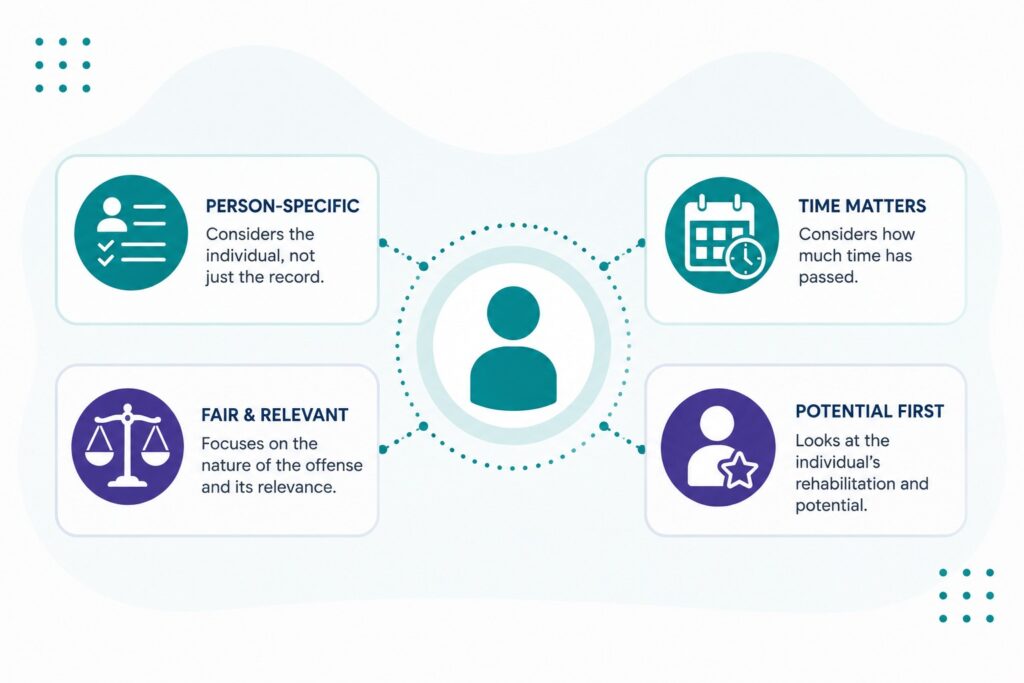
Individualized assessment is the practice of evaluating a specific criminal record in the context of a specific job, rather than applying a fixed, one-size-fits-all rule to every applicant with any criminal history. It’s referenced throughout EEOC guidance and required outright under many state and local Fair Chance laws, and it represents a meaningful shift away from blanket disqualification policies that treat every criminal record the same regardless of context.

Important: Blanket policies that automatically disqualify any applicant with a criminal record, without individualized review, can create legal exposure under both federal disparate impact guidance and an increasing number of state and local Fair Chance laws.
What Individualized Assessment Actually Requires
Rather than treating “has a criminal record” as a single yes/no filter, individualized assessment asks an employer to weigh several specific factors before making a decision based on that record:
- The nature and severity of the specific offense
- How much time has passed since the conviction or completion of any sentence
- The specific duties and responsibilities of the position being filled
- Whether the offense is actually relevant to those job duties
- Evidence of rehabilitation, such as consistent employment history since the offense, or completion of relevant programs
The underlying idea is straightforward: a decade-old, low-level offense with no relevance to the job is a fundamentally different situation than a recent conviction directly related to the core responsibilities of the role, and treating both identically under a blanket policy ignores that difference entirely.
Where This Comes From: EEOC Guidance
The Equal Employment Opportunity Commission has issued guidance addressing how criminal record policies can create disparate impact discrimination under Title VII, even when a policy appears neutral on its face. Because criminal record rates differ across demographic groups, a blanket exclusion policy, “no felony convictions, ever, for any position”, can have a disproportionate effect on certain groups, and the EEOC has specifically pointed to individualized assessment as a practice that helps employers avoid this kind of disparate impact exposure. This EEOC guidance isn’t itself a binding law in the way a statute is, but it shapes how courts and agencies evaluate whether a hiring policy crosses into discriminatory territory.
Where It’s a Legal Requirement, Not Just Guidance
Beyond the EEOC’s guidance, a number of state and local Fair Chance laws make individualized assessment a specific, mandatory legal requirement, not just a best practice. In these jurisdictions, an employer generally cannot deny employment based on a criminal record without first documenting that they considered the relevant factors, and in many cases, without giving the applicant a chance to respond or provide additional context before a final decision is made. Because these requirements vary by location, an employer’s obligations can differ meaningfully depending on which state or city the position is based in.
How Individualized Assessment Works in Practice
A reasonable individualized assessment process generally involves a few concrete steps:
- Identifying the specific record and confirming its accuracy before it’s considered
- Evaluating the offense against the actual duties of the position, not a generic standard
- Considering time elapsed and any evidence of rehabilitation
- Documenting the reasoning behind the decision, particularly if the outcome is a denial
- In jurisdictions that require it, providing the applicant an opportunity to respond with additional context before the decision is finalized
Documentation matters more than it might seem. If a denial decision is ever challenged, an employer’s ability to show that a genuine, individualized review occurred, rather than an automatic rule, is often the difference between a defensible decision and a real legal problem.
Why Blanket Policies Create Risk
A policy that automatically disqualifies anyone with a felony, or any criminal record at all, regardless of the job or the offense’s relevance, is exactly the kind of practice individualized assessment requirements exist to prevent. Beyond the disparate impact concern under federal guidance, a growing number of state and local laws make this kind of blanket policy an outright, independent violation, separate from any federal discrimination claim. Employers relying on rigid, automatic disqualification rules face compounding legal exposure from multiple directions at once.
What Individualized Assessment Doesn’t Guarantee
Individualized assessment doesn’t mean every applicant with a criminal record must be hired, or that employers can’t decline to hire someone based on a genuinely relevant record. It means the decision has to actually weigh the relevant factors rather than being made automatically. A recent, serious offense directly related to a position’s core responsibilities can still result in a legitimate denial, individualized assessment simply requires that the reasoning behind that denial be genuine and documented, not reflexive.
Building It Into a Hiring Process
Employers looking to build individualized assessment into their standard hiring workflow generally benefit from having a consistent internal framework, the same factors weighed the same way for every applicant, rather than making ad hoc judgment calls that vary case by case in ways that could appear arbitrary or inconsistent later. Consistency itself is part of what makes an individualized assessment process defensible, applying the same considerations evenly across applicants, even though the outcome for each individual case may differ based on its specific facts.
Common Misunderstandings
“Individualized assessment means I have to hire anyone with a criminal record.” Not true. It requires genuine consideration of relevant factors, not an automatic hiring outcome.
“This is only required in certain states.” Partially true. It’s a specific legal requirement in states and cities with Fair Chance laws, but it’s also referenced in federal EEOC guidance more broadly, relevant even where it isn’t an explicit statutory requirement.
“A blanket policy is fine as long as it’s applied consistently.” Consistency in applying a blanket rule doesn’t resolve the underlying disparate impact or Fair Chance law concern, the issue is the blanket nature of the policy itself, not whether it’s applied evenly.
The Bottom Line
Individualized assessment shifts hiring decisions involving criminal history away from automatic, one-size-fits-all rules and toward genuine consideration of the offense, the job, and the time that’s passed. It’s both a recommended best practice under federal guidance and, in a growing number of jurisdictions, an outright legal requirement. Employers who build a consistent, documented individualized assessment process into their hiring workflow put themselves in a meaningfully stronger position than those relying on blanket disqualification policies.