
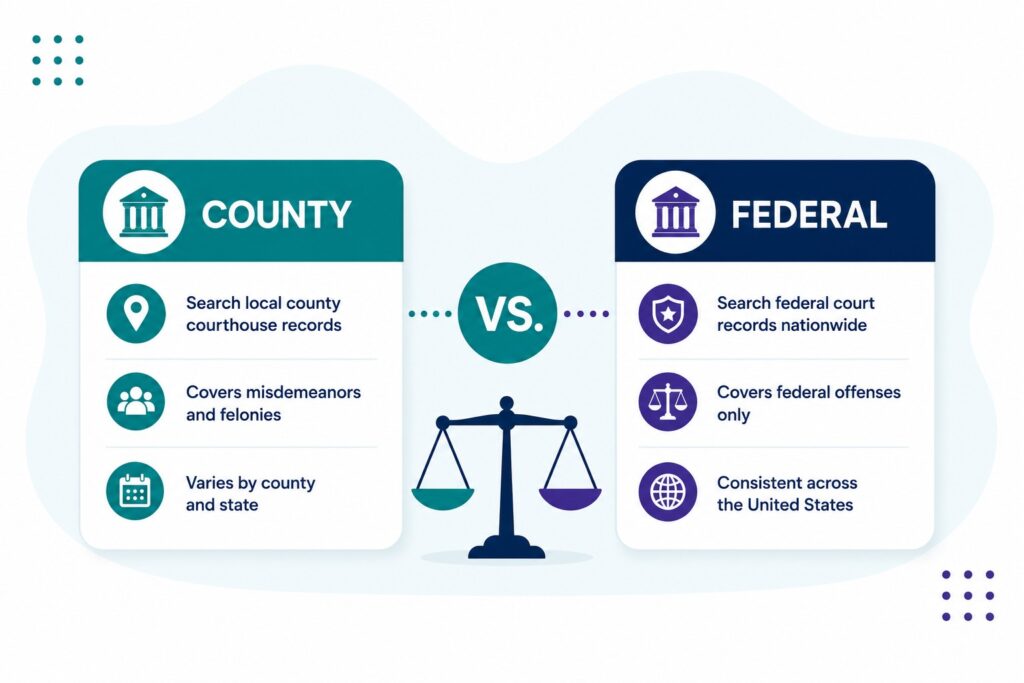
County and federal criminal searches cover fundamentally different parts of the court system, and neither one alone gives a complete picture of someone’s criminal history. Most criminal cases are handled at the county level, while a much narrower category of offenses ends up in federal court instead. Understanding the difference matters for building a background check that actually covers what it needs to.

Important: County and federal criminal searches cover separate court systems entirely. Running one without the other leaves a real gap, most thorough background checks include both, not one or the other.
What County Criminal Searches Cover
County criminal searches query records maintained directly by local county courts, and this is where the overwhelming majority of criminal cases in the United States are actually prosecuted, everything from misdemeanors to most felonies. Coverage and accessibility vary meaningfully from one county to another, depending on:
- How far back that specific court’s electronic records extend
- Whether older records require in-person or archived retrieval rather than an electronic search
- The court’s general responsiveness and processing time for record requests
Some counties maintain deep, easily searchable electronic records going back decades. Others have far more limited electronic access, requiring manual retrieval for anything beyond a fairly recent window. This inconsistency is exactly why a screening company’s direct relationships and experience with specific county court systems can meaningfully affect how quickly and accurately a search comes back.
What Federal Criminal Searches Cover
Federal criminal searches cover cases prosecuted in U.S. District Courts, a much narrower category of offenses that typically cross state lines, violate federal statutes specifically, or involve federal agencies directly. Common examples include:
- Wire fraud and mail fraud
- Embezzlement involving federally insured institutions
- Federal drug trafficking offenses
- Interstate crimes, including certain kidnapping or trafficking cases
- Federal tax offenses
- White-collar crimes prosecuted at the federal level, such as securities fraud
Federal court recordkeeping tends to be more centralized and consistent than county-level systems, largely because there are far fewer federal district courts than there are county courts nationwide, making standardized search access more practical to maintain.
Why Most Background Checks Need Both
Because county and federal courts handle entirely separate categories of offenses, a criminal history search that only covers one will systematically miss whatever falls under the other. A county search will never surface a federal wire fraud conviction, and a federal search will never surface a county-level assault charge. Neither search is “more thorough” than the other in a general sense, they’re simply covering different territory entirely, and a comprehensive background check needs to account for both, not substitute one for the other.
Determining Which Counties to Search
Since county searches only cover the specific county requested, identifying every relevant county an applicant has actually lived in matters as much as running the search itself. This is typically where an SSN trace comes in, surfacing address history that helps identify which counties are actually worth searching, rather than relying solely on what an applicant lists on an application, which may be incomplete or may not go back far enough.
How National Databases Fit Into This
National criminal database searches are sometimes treated as a substitute for running individual county and federal searches, but they generally shouldn’t be. These compiled databases pull from a wide but inconsistent range of sources and often lag behind real-time court records, they’re useful for identifying potential leads, but reputable screening practice verifies any relevant hit directly with the actual county or federal court before including it in a final report, rather than reporting an unverified database match as though it were confirmed.
Do Reporting Rules Differ Between the Two?
FCRA reporting limitations generally apply the same way regardless of whether a conviction originated at the county or federal level, convictions can often be reported indefinitely, while non-conviction information typically follows shorter reporting windows. State law variations on top of the federal baseline also apply regardless of which court system a case came from. The distinction between county and federal isn’t primarily about how long something can be reported, it’s about which court system actually has jurisdiction over that type of offense in the first place.
Practical Considerations for Employers
- Confirm that a screening provider runs both county and federal searches as standard practice, not just one
- Understand that county search depth depends partly on the specific counties involved, some are simply more accessible than others
- Don’t assume a national database search alone is equivalent to running direct county and federal searches
- Use SSN trace results to help identify every county genuinely worth searching, not just the ones an applicant explicitly lists
Common Misunderstandings
“A federal search covers all criminal history.” It doesn’t. Federal courts handle a specific, narrower category of offenses, most criminal cases are handled at the county level instead.
“A county search is enough on its own.” Not necessarily. It won’t surface any offense that was prosecuted federally, a genuinely separate court system.
“A national database search covers both automatically.” Coverage varies and often lags behind real-time court records for both county and federal cases, it’s a research tool, not a replacement for direct verification.
The Bottom Line
County and federal criminal searches aren’t competing options, they’re complementary ones covering entirely different parts of the court system. A background check that only includes one, or relies solely on a compiled national database, leaves a real gap in coverage. Understanding which court system handles which types of offenses helps explain why a thorough screening process typically includes both, verified at the source, rather than treating either as a complete answer on its own.