
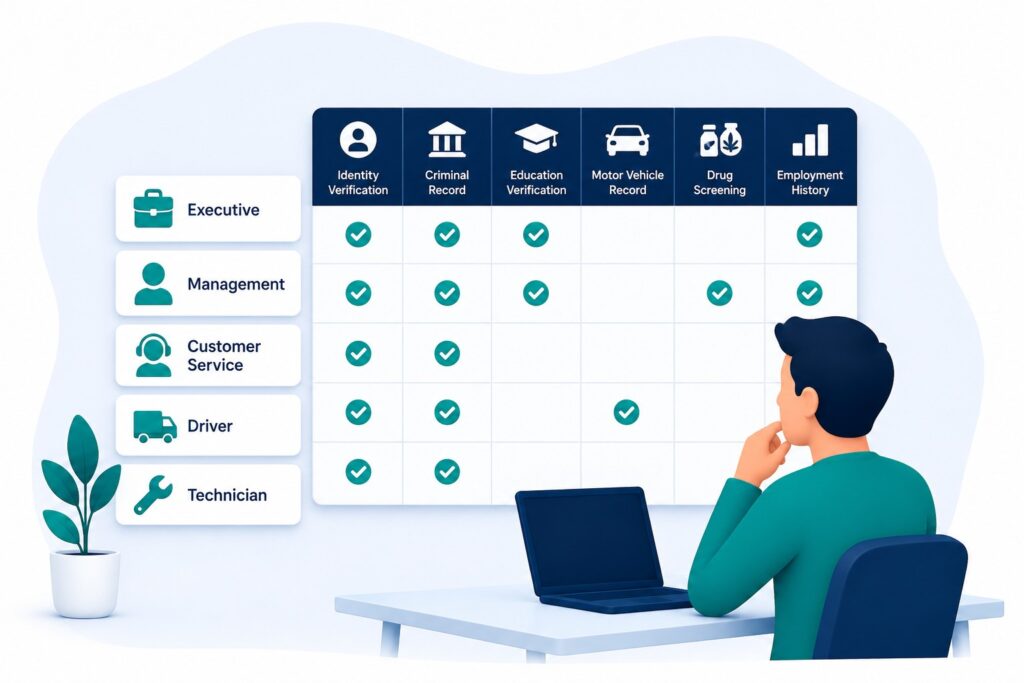
Not every job needs the same background check. A screening package built for an administrative assistant doesn’t need the same components as one built for a CFO or a commercial truck driver, and running the wrong searches, too little for a high-risk role, or unnecessarily invasive ones for a low-risk role, creates its own problems, either real risk exposure or unnecessary cost and potential legal scrutiny. This guide walks through a practical framework for matching background check components to specific types of positions.

Important: Job-relatedness matters legally, not just practically. Requesting information unrelated to a position’s actual duties, such as a credit check for a role with no financial responsibility, can create legal exposure under state law and EEOC guidance, independent of whether the employer had good intentions.
The Baseline: What Nearly Every Position Should Include
Regardless of role, most employment screening programs start with a common foundation:
- SSN trace, to surface address history and identify relevant jurisdictions
- County criminal search in every jurisdiction identified
- National criminal database search, used to identify additional leads, not as a standalone result
- Employment verification, confirming reported work history
From this baseline, the right additional components depend heavily on the specific responsibilities, risk profile, and regulatory environment of the role.
Administrative Assistant / General Office Roles
These roles typically carry lower inherent risk than positions involving direct financial control, safety responsibility, or vulnerable populations, but they often have access to sensitive company or client information. Reasonable additions to the baseline:
- Education verification, if a degree or certification was represented on the application
- Employment verification with a slightly deeper reference check, given regular access to internal systems and communications
Credit checks and drug testing are generally not job-related for a typical administrative role and may run into state restrictions if applied without a clear justification tied to the specific position.
CFO and Other Executive Financial Roles
Positions with direct control over company finances, banking relationships, or fiduciary responsibility warrant a meaningfully deeper screen, given the scale of potential harm from fraud or financial misconduct at this level.
- Federal criminal search, given the frequency of financial crimes prosecuted federally
- Credit report, where state law permits it for fiduciary or financial-control positions specifically
- Civil record search, to identify judgments, liens, or litigation history relevant to financial conduct
- Professional license verification, for roles requiring CPA or other financial credentials
- Global watchlist and sanctions screening, particularly for roles involving international transactions or banking relationships
This is one of the few role categories where a credit check is most likely to be both job-related and legally defensible, given the direct connection between financial responsibility and credit history relevance, though state-specific restrictions still need to be confirmed.
Machinist and Skilled Trades Roles
Positions involving heavy machinery and physical equipment carry workplace safety as the primary consideration, more than financial or reputational risk.
- Criminal history focused on relevant safety concerns rather than a broad, unrelated review
- Drug testing, given the safety implications of impairment around machinery
- Verification of any required trade certifications or licenses
Warehouse Workers
Similar risk profile to skilled trades roles, physical safety and equipment operation are the primary concerns, plus inventory-related trust considerations.
- Criminal history search, standard baseline
- Drug testing, particularly for roles operating forklifts or other equipment
- MVR check, if the role includes any driving responsibilities, such as operating a forklift on public roads or occasional delivery duties
Truck Drivers and Other DOT-Regulated Positions
This category carries the most extensive, and most federally mandated, screening requirements of any role type discussed here, since DOT regulations leave little discretion to the employer.
- MVR check, required and closely scrutinized given the direct safety relevance
- DOT-compliant drug and alcohol testing, following federally mandated procedures and cutoff levels
- Criminal history search, standard baseline
- Verification of CDL status and any required endorsements
- FMCSA Drug and Alcohol Clearinghouse query, specifically required for CDL holders
Employers should treat DOT-regulated positions as following a fundamentally different, federally prescribed screening framework rather than the general employer-discretion model that applies to most other roles.
Social Workers and Similar Roles Serving Vulnerable Populations
Positions involving direct, often unsupervised, contact with children, the elderly, or other vulnerable populations warrant an expanded screening approach, and are frequently subject to specific state licensing and screening mandates beyond what a general employer would choose voluntarily.
- Expanded criminal history search, often required to cover a longer lookback period than standard state limits allow for this category of role
- Sex offender registry search, standard for any role involving vulnerable populations
- Professional license verification, confirming active social work licensure
- Child abuse and neglect registry check, where required by state law for this type of position
Many states carry specific statutory screening requirements for roles serving vulnerable populations that exceed general FCRA and state Ban the Box protections, employers in this category should confirm the specific mandated screening components for their state and role type, since these often aren’t optional or subject to standard individualized assessment exceptions the way other criminal history considerations might be.
Physical Therapists and Other Licensed Healthcare Roles
Healthcare positions combine patient safety considerations with strict licensing requirements.
- Professional license verification, confirming active, unrestricted licensure with the relevant state board
- Criminal history search, standard baseline plus any state-specific healthcare screening mandates
- Healthcare sanctions and exclusion list screening, checking against federal program exclusion databases
- Drug testing, common given direct patient care responsibilities
- Education verification, confirming the specific degree required for licensure
Retail Workers
Generally lower risk, though cash handling and customer-facing responsibility still warrant a baseline screen.
- Standard criminal history search
- Employment verification
Credit checks and drug testing are less commonly job-related for typical retail positions, and state restrictions on both are increasingly common, employers should have a specific justification tied to the role before including either.
A Few Additional Role Categories Worth Covering
Childcare and education workers
Similar considerations to social work roles, expanded criminal history screening, sex offender registry checks, and often state-mandated fingerprint-based background checks specific to childcare licensing requirements.
Security guards
Often subject to state-specific licensing and screening requirements for private security work, sometimes including firearms-related background checks if the position is armed.
IT and roles with significant data access
Criminal history focused on fraud and cybercrime-related offenses specifically, given the access these roles have to sensitive systems and data, alongside standard baseline screening.
Financial advisors and loan officers
Similar to executive financial roles, credit checks where permissible, civil record searches, and verification of required industry licenses such as Series 7 or state insurance licensing.
Building a Role-Based Screening Policy
Rather than deciding screening components case by case, employers benefit from building a documented policy that maps specific search components to defined role categories in advance, tied to the actual duties and risk profile of each category rather than decided informally at the time of each individual hire. This approach supports both consistency, applying the same standard to every applicant in a given role category, and defensibility, since a documented, role-based rationale is easier to justify than an ad hoc decision made without a clear connection to job duties.
Common Misunderstandings
“More screening is always safer.” Not necessarily. Screening components unrelated to a role’s actual duties can create legal exposure rather than reducing it, particularly around credit checks and overly broad criminal history use.
“DOT requirements are just a stricter version of standard screening.” Not quite. DOT-regulated screening follows a specific federally mandated framework with far less employer discretion than standard employment screening.
“The same screening package works for every role at the company.” Rarely true in practice. A single, undifferentiated screening policy applied to every role regardless of duties tends to either under-screen high-risk positions or over-screen low-risk ones.
The Bottom Line
The right background check components depend on what a role actually involves, financial responsibility, safety-sensitive equipment, vulnerable populations, licensing requirements, not a one-size-fits-all package applied uniformly across every position. Building a documented, role-based screening policy tied to genuine job relevance protects both compliance and consistency, while giving employers a defensible answer for why each specific search was included for each specific type of role.