
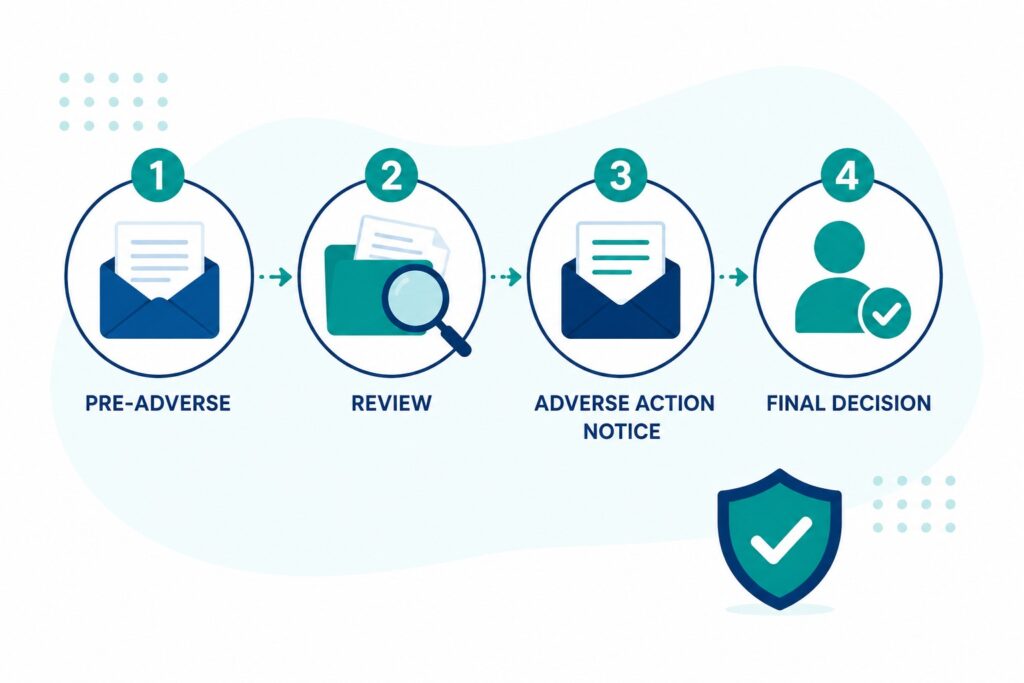
The adverse action process is one of the most important, and most frequently mishandled, requirements under the Fair Credit Reporting Act (FCRA). It exists to make sure that before a background check costs someone a job, they get a real opportunity to see the report and correct anything wrong with it. Skipping or rushing this process is consistently one of the leading causes of FCRA litigation, even in cases where the background check itself was completely accurate.
This guide walks through exactly what triggers the adverse action process, what each required notice has to include, how long employers actually need to wait, and where state and local law impose stricter rules than the federal baseline.

Important: Adverse action requirements are triggered by the decision itself, not by whether the employer explains the reason to the applicant. An employer does not need to disclose that a background check was the deciding factor to still be required to follow the adverse action process.
What Counts as Adverse Action
Adverse action is broader than most people assume. It is not limited to a straightforward “we’re not hiring you” rejection. Under the FCRA, adverse action can include:
- Declining to hire an applicant
- Rescinding a conditional job offer after a background check is completed
- Denying a promotion or reassignment based on a background check
- Terminating an existing employee based on a background check
- Denying a volunteer or contractor position where a consumer report was used
The common thread is simple: if a consumer report played any part, even a partial part, in a negative employment decision, the adverse action process applies. Employers sometimes assume that if other factors also contributed to the decision, the FCRA’s requirements don’t apply. That is incorrect. The report only needs to be a contributing factor, not the sole reason, for adverse action obligations to be triggered.
The Two-Step Process
The FCRA’s adverse action requirement is built around two distinct notices, sent at two distinct points in time, with a waiting period in between. Skipping either notice, or collapsing the waiting period, breaks the process even if the final decision itself was reasonable.
Step 1: Pre-adverse action notice
Before making a final decision, the employer must provide the applicant with:
- A copy of the actual consumer report the decision is based on
- A copy of “A Summary of Your Rights Under the Fair Credit Reporting Act,” the standardized document published by the FTC
This notice is not a formality, it has to actually reach the applicant with enough time for them to meaningfully review the report before anything is finalized. Sending it as an afterthought, or bundling it with the rejection itself, defeats its purpose.
Step 2: The waiting period
This is where a lot of confusion comes in. The FCRA itself does not specify an exact number of days that must pass between the pre-adverse action notice and a final decision. What it requires is a “reasonable” period, and the widely followed industry standard, based on guidance from the FTC over the years, is approximately five business days.
That five-day figure is a practice, not a statute. It is a reasonable, well-established benchmark, but employers should understand that it is not a fixed legal deadline they are technically satisfying just by counting to five. The actual legal standard is reasonableness, and several states and cities impose their own specific, legally binding waiting periods that override the general federal practice, covered in more detail below.
Step 3: Final adverse action notice
If the employer proceeds with the negative decision after the waiting period, a final adverse action notice must be sent. This notice must include:
- The name, address, and phone number of the consumer reporting agency that supplied the report
- A statement that the CRA did not make the hiring decision and is unable to explain the specific reason for it
- Notice of the applicant’s right to dispute the accuracy of the report with the CRA
- Notice of the applicant’s right to request a free copy of the report from the CRA within 60 days
Employers are not required to explain their reasoning for the decision itself in this notice, only to confirm that the process has concluded and to point the applicant toward their dispute rights.
How Notices Should Be Delivered
The FCRA does not mandate a single specific delivery method, notices can be sent by mail, email, or through an electronic applicant tracking or disclosure platform, as long as delivery can be reasonably confirmed and documented. What matters most is that the employer can demonstrate the notice was actually sent, and when. Employers using electronic systems should retain timestamped delivery records, since these records become the primary evidence of compliance if a dispute or claim arises later.
Where State and Local Law Sets Stricter Timing
While five business days is the common federal practice, a growing number of states and cities have enacted their own binding waiting periods that are longer, and legally mandatory, not just customary. Employers operating in these jurisdictions must follow the local requirement, since state and local law can add protections beyond the FCRA, but cannot reduce them.
Examples of jurisdictions with specific mandated waiting periods or additional procedural steps include cities and states with Fair Chance ordinances requiring individualized assessment documentation, extended response windows before a final decision can be made, and additional written notice of the specific reasons or records being considered. Because these requirements vary by location and change over time, employers with hiring operations in multiple states should confirm the specific adverse action timeline required in each jurisdiction where they screen candidates, rather than applying a single national timeline everywhere.
What Happens If the Applicant Doesn’t Respond
Employers are not required to indefinitely delay a hiring decision if an applicant does not respond during the waiting period. Once a reasonable period has passed without a dispute or response, the employer may proceed with the final adverse action notice and finalize the decision. However, if an applicant does respond, even close to the end of the waiting period, with a dispute or new information, the employer should evaluate that response before proceeding, rather than treating the waiting period as a rigid countdown that overrides new information received before its expiration.
Disputes Filed During the Process
If an applicant files a dispute with the consumer reporting agency during the pre-adverse action waiting period, that dispute does not automatically pause the employer’s hiring timeline. The FCRA does not require employers to delay a final decision while a dispute is being investigated by the CRA. This is precisely why the pre-adverse action window exists in the first place, to give applicants a meaningful opportunity to flag problems before, rather than after, a decision becomes final.
Documentation That Protects Employers
Because adverse action claims often hinge on whether required notices were actually sent and whether enough time passed, documentation is the employer’s primary defense in a dispute or lawsuit. Employers should maintain records showing:
- The date the pre-adverse action notice was sent, and proof of delivery
- A copy of the report and Summary of Rights included with that notice
- The date the final adverse action notice was sent, if the decision proceeded
- Consistent application of the same waiting period across all applicants, not just some
Inconsistent practice, following the process carefully for some applicants but rushing or skipping it for others, is a common pattern that plaintiffs’ attorneys look for, since it can suggest the process wasn’t a genuine, consistently applied policy.
Common Mistakes in the Adverse Action Process
Sending both notices at once, or too close together. If the final notice goes out before a reasonable amount of time has actually passed, the waiting period requirement hasn’t been meaningfully satisfied, regardless of what the calendar technically shows.
Failing to include the actual report. A pre-adverse action notice that references a background check without attaching the report itself does not satisfy the requirement. The applicant must receive the actual report being relied on.
Using an outdated Summary of Rights document. The FTC periodically updates this standardized form. Employers should confirm they are using the current version rather than one that may have been in use for years without review.
Treating the process as optional for internal moves. Adverse action requirements apply to promotion, reassignment, and retention decisions based on a background check, not only to new hire rejections.
The Bottom Line
The adverse action process exists to insert a meaningful pause, and a real notice, before a background check permanently costs someone a job or a promotion. Getting the two-step notice sequence right, understanding that the standard waiting period is a practice rather than a fixed statute, and confirming any stricter state or local timing requirements, are what separate a defensible, compliant process from one that creates unnecessary legal exposure. Consistency matters as much as the individual steps themselves, a process followed carefully for some applicants and rushed for others is a pattern that tends to draw scrutiny.