
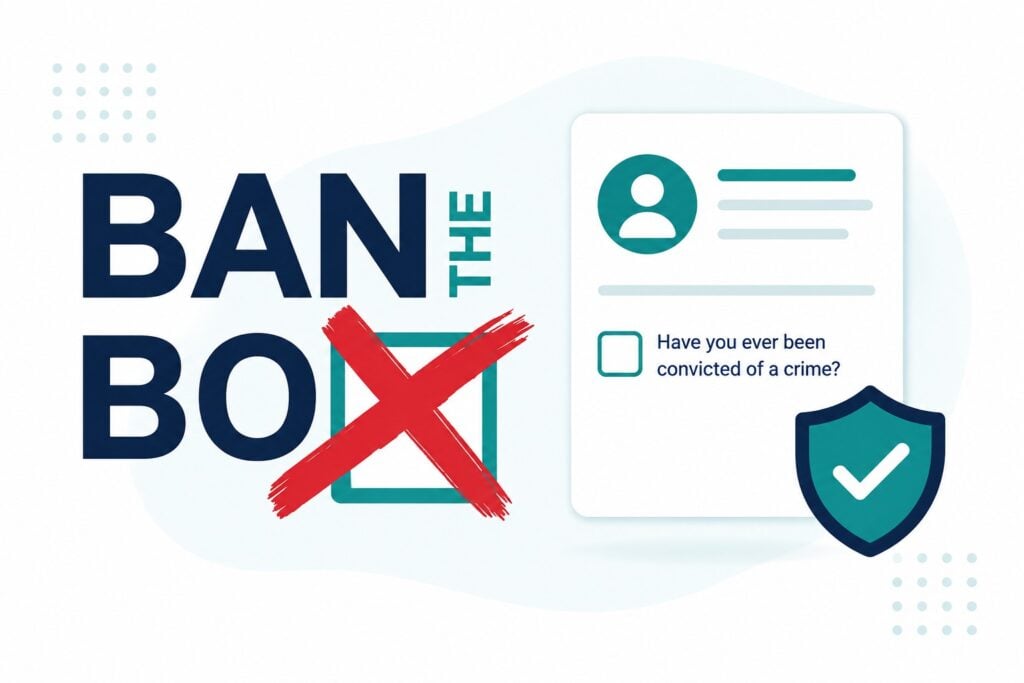
“Ban the Box” is one of the most widely referenced terms in employment screening, but it’s also one of the most commonly misunderstood. Many people assume it means employers can’t ask about criminal history at all. That isn’t accurate. Ban the Box laws don’t eliminate criminal history questions, they regulate when in the hiring process those questions can be asked.

Important: Ban the Box laws vary significantly by state and city, including which employers are covered, when criminal history can be considered, and what exceptions apply. Employers should confirm the specific requirements in every jurisdiction where they hire.
What Ban the Box Actually Means
The name comes from the literal checkbox that used to appear on many job applications, the one asking “Have you ever been convicted of a crime?” Ban the Box laws remove that checkbox from the initial application, delaying criminal history inquiries to a later point in the hiring process, typically after an initial interview or after a conditional job offer has been made.
The goal is straightforward: give applicants a chance to be evaluated on their qualifications first, rather than being screened out automatically before an employer ever reviews their skills or experience.
How It Works in Practice
Ban the Box laws generally restrict two things: when an employer can ask about criminal history, and in many jurisdictions, when a background check can actually be run. Depending on the specific law, the delay point may be:
- After the first interview has occurred
- After a conditional offer of employment has been extended
- At some other defined stage specified by the applicable law
Once that stage is reached, the employer is generally free to ask about criminal history and request a background check, subject to whatever additional requirements the law imposes from that point forward.
Ban the Box vs. Fair Chance Laws
These two terms are often used interchangeably, but they aren’t quite the same thing. Ban the Box specifically refers to delaying the criminal history question. Fair Chance laws are broader, they often include Ban the Box provisions, but also add requirements for what happens after criminal history is disclosed, such as requiring an individualized assessment before an employer can deny employment based on a record.
An individualized assessment generally means the employer must evaluate the specific nature and severity of the offense, how much time has passed, and its relevance to the actual job, rather than applying a blanket policy that automatically disqualifies anyone with a criminal record. Many Fair Chance laws also require the employer to notify the applicant if they intend to deny employment based on a criminal record, and give the applicant a chance to respond before the decision is finalized, similar in spirit to the FCRA’s adverse action process, but under separate state or local authority.
Who These Laws Cover
Coverage varies significantly depending on the jurisdiction. Some Ban the Box laws apply only to public sector employers and government hiring. Others extend to private employers as well, sometimes only above a certain number of employees, sometimes regardless of size. A growing number of jurisdictions apply these laws broadly across both public and private employment.
Because coverage differs so much by location, an employer operating in multiple states or cities cannot assume a single company-wide policy will satisfy every jurisdiction’s requirements. What applies in one city may not apply at all, or may apply differently, just a few miles away in another municipality.
Common Exceptions
Most Ban the Box and Fair Chance laws include specific carve-outs for certain positions or industries where earlier criminal history review is still permitted, often due to separate legal requirements or heightened public safety considerations. Common exceptions include:
- Law enforcement and criminal justice positions
- Positions working directly with children, the elderly, or other vulnerable populations
- Certain financial services roles subject to separate federal licensing or bonding requirements
- Positions where a separate federal or state law already mandates a criminal background check as a condition of employment
These exceptions are jurisdiction-specific and should not be assumed to apply universally. A position that qualifies for an exception in one state may not automatically qualify in another.
What Employers Should Do to Comply
Building a compliant process generally starts with confirming exactly which Ban the Box or Fair Chance laws apply in each jurisdiction where the employer hires, since requirements can differ by state, county, and even city. From there, employers typically need to:
- Remove criminal history questions from initial job applications where required
- Train hiring managers and recruiters on when criminal history questions and background checks are legally permitted during the process
- Build individualized assessment procedures into the hiring workflow where Fair Chance requirements apply
- Document the reasoning behind any adverse decision based on criminal history, particularly where individualized assessment is legally required
Removing a checkbox from an application is the easy, visible part of compliance. The harder, less visible part is making sure hiring managers actually understand when they’re permitted to ask about or act on criminal history later in the process, since most violations come from inconsistent practice rather than a flawed written policy.
What Happens If Employers Don’t Comply
Penalties for Ban the Box and Fair Chance violations vary by jurisdiction, but they can include fines, civil penalties, and in some cases private lawsuits brought by affected applicants. Some jurisdictions also allow for enforcement through a state or local human rights or labor agency, separate from any federal claim under the FCRA. Because these laws exist independently of federal law, an employer can be fully FCRA-compliant and still be in violation of a state or local Ban the Box or Fair Chance requirement.
Common Misunderstandings
“Ban the Box means employers can never ask about criminal history.” Not true. It delays when the question can be asked, it doesn’t eliminate the question entirely.
“These laws are the same everywhere.” Not true. Coverage, timing requirements, and exceptions vary significantly by state and city.
“Ban the Box and Fair Chance laws are the same thing.” Related, but not identical. Ban the Box addresses timing of the question; Fair Chance laws often go further, adding individualized assessment and notice requirements after disclosure.
“If my state doesn’t have a law, I don’t need to think about this.” Not necessarily. City and county-level ordinances frequently impose separate requirements beyond whatever exists at the state level.
The Bottom Line
Ban the Box laws are about sequencing, giving applicants a chance to be evaluated on their qualifications before criminal history enters the conversation, not about eliminating criminal history review altogether. Employers building a compliant hiring process need to understand exactly which laws apply in each location where they hire, since requirements, covered employers, and exceptions can all vary meaningfully between a state, a county, and a city sitting inside it.