
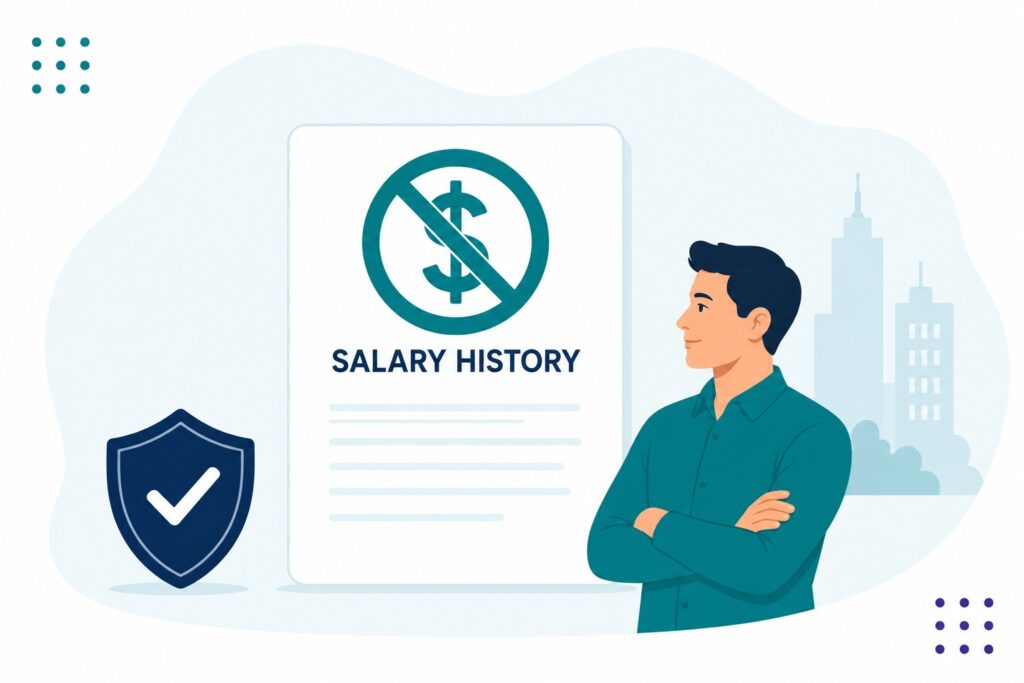
A salary history ban is a state or local law that restricts employers from asking applicants about their previous pay, or in some cases, from using previously disclosed salary history to set an offer, even if the applicant volunteers it. These laws have spread quickly over the past several years, and they’ve meaningfully changed how compensation conversations happen during hiring in a growing number of jurisdictions.

Important: Salary history ban laws vary significantly by state and city, including whether they restrict asking, restrict relying on voluntarily disclosed information, or both. Employers should confirm the specific requirements in every jurisdiction where they hire.
Why Salary History Bans Exist
The reasoning behind these laws centers on pay equity. If an employer bases a new offer on an applicant’s previous salary, and that previous salary was itself set unfairly, due to prior wage discrimination, for example, that gap can follow the person from job to job indefinitely, since each new employer anchors their offer to the last one instead of evaluating the role and the candidate’s qualifications independently. Salary history bans are designed to break that cycle by removing prior pay as a reference point altogether.
What Salary History Bans Typically Restrict
Depending on the specific jurisdiction, a salary history ban may restrict one or more of the following:
- Directly asking an applicant about their current or past salary during the hiring process
- Requesting salary history from a previous employer as part of a reference or verification check
- Relying on salary history, even if an applicant volunteers it unprompted, to determine a new offer
- Retaliating against an applicant who declines to disclose salary history when asked
Not every law covers all of these categories, some restrict only the direct question, while others go further and restrict reliance on the information even when it’s disclosed voluntarily. This distinction matters quite a bit in practice, since it changes what an employer can legally do even if an applicant brings up their prior salary on their own.
Why This Varies Meaningfully by Location
Salary history ban laws exist at the state level in a substantial number of states, and separately at the city or county level in several additional jurisdictions that don’t have a statewide law. Because of this layering, an employer operating in multiple locations may be subject to a state-level ban in one location and a separate, potentially differently worded, city-level ban in another, even within the same state. Confirming the specific rule for each individual hiring location, rather than assuming a single company-wide policy covers everywhere, is genuinely necessary given how much these laws differ in scope and specific restrictions.
What Employers Can Still Ask
Salary history bans generally don’t prevent an employer from asking about an applicant’s salary expectations for the new role, only about their past compensation. Employers can typically still ask questions like what compensation range the applicant is looking for, and can share the position’s posted salary range or budget, without running into most salary history restrictions. The distinction is between asking what someone earned before versus what they’re seeking now, the former is restricted in many places, the latter generally is not.
Overlap With Pay Transparency Laws
Salary history bans are often discussed alongside a related but distinct category: pay transparency laws, which require employers to disclose a salary range in job postings rather than restricting questions about past pay. Some jurisdictions have both types of laws simultaneously, while others have only one or neither. Employers should treat these as two separate compliance requirements rather than assuming a jurisdiction with one type of law necessarily has the other.
How These Laws Are Enforced
Violations of salary history ban laws are typically enforced through the state or local labor agency responsible for wage and hour law, separate from any FCRA-related claim. Some jurisdictions also allow affected applicants to bring a private lawsuit for a violation. Because enforcement mechanisms and potential penalties vary by location, the practical consequences of noncompliance can differ meaningfully depending on where the violation occurred.
Building Compliant Practices Around This
- Train recruiters and hiring managers to avoid salary history questions entirely in covered jurisdictions, rather than relying on applicants to decline voluntarily
- Update standard interview questions and application forms to remove salary history fields where prohibited
- Confirm whether the applicable law also restricts relying on voluntarily disclosed salary information, not just the act of asking
- Focus compensation conversations on salary expectations and posted ranges rather than prior pay
Common Misunderstandings
“These laws only restrict asking directly.” Not always. Some jurisdictions also restrict relying on salary history even when an applicant offers it voluntarily.
“If my state doesn’t have a salary history ban, I don’t need to think about it.” Not necessarily. A number of cities and counties have their own separate bans even in states without a statewide law.
“Salary history bans and pay transparency laws are the same thing.” They’re related but distinct, one restricts asking about past pay, the other requires disclosing a range for the new role. A jurisdiction may have either, both, or neither.
The Bottom Line
Salary history bans have reshaped how compensation conversations happen during hiring in a growing number of states and cities, shifting the focus away from what an applicant earned previously and toward what the role itself pays and what the applicant is seeking now. Because coverage and specific restrictions vary significantly by jurisdiction, employers hiring across multiple locations need to confirm the specific rule in each place they hire, rather than applying a single national policy everywhere.