
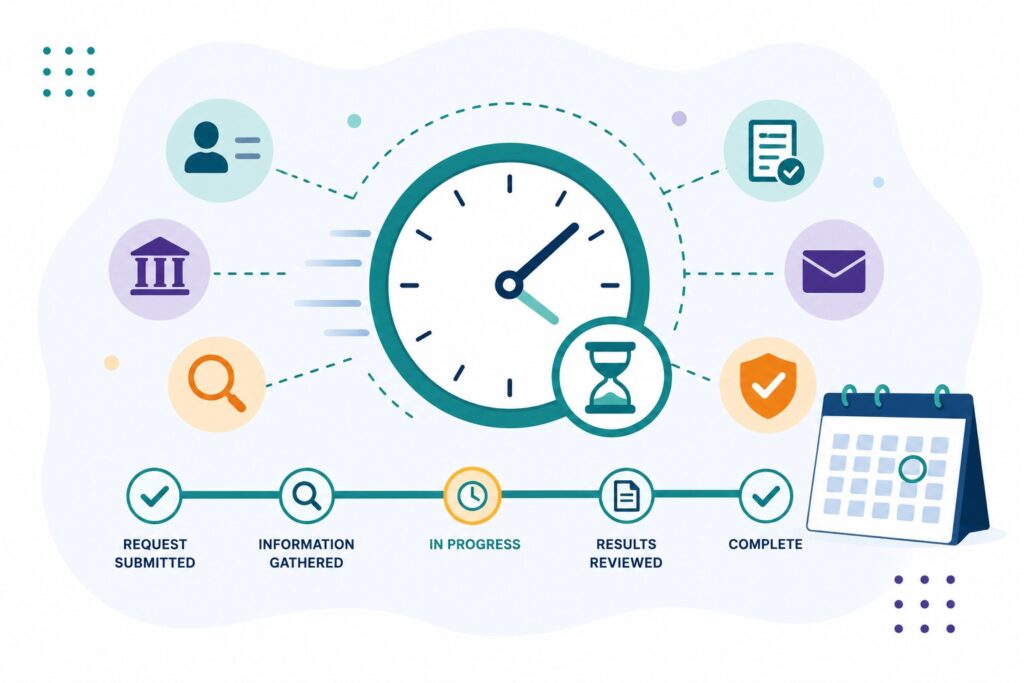
You signed the authorization, and now nothing is happening. No update, no news, and no idea whether that means something went wrong. The waiting is the worst part of a background check for most applicants, so here is what is actually happening on the other end.

Important: There is no legal deadline for completing a background check. The 30 day figure people often cite is the window a screening company has to investigate a dispute, which is a different process entirely.
The Short Answer
Most standard employment background checks come back in 1 to 3 business days. A more complete range is 1 to 5, depending on what the employer ordered and where you have lived.
A small share run considerably longer. When a check drags past a week, it is almost always waiting on 1 specific thing rather than moving slowly across the board.
Why the Range Is So Wide
A background check is not 1 search. It is several running at once, and the report is only finished when the slowest one finishes. Typical timing by component:
- Identity and SSN trace: minutes. This runs first because it determines which jurisdictions get searched
- National database search: minutes, though any hit has to be confirmed at the source court, which adds time
- Federal criminal search: usually same day, since federal court records are centralized and digitized
- County criminal search: 1 to 3 business days when records are online, longer when they are not
- Statewide criminal search: generally fast where a state repository exists and permits employment access
- Driving records: usually same day, straight from the state motor vehicle agency
- Credit report: minutes
- Employment verification: 2 to 3 business days, entirely dependent on your former employer answering
- Education verification: 2 to 5 business days, faster through the National Student Clearinghouse than school by school
- Drug testing: adds 2 to 3 days for a negative result, longer if a medical review officer has to follow up
- International records: 1 to 4 weeks, sometimes more
The pattern is clear. Anything pulled from a digitized system is close to instant. Anything that depends on a human being answering a request is where time goes.
What Actually Causes Delays
County courts that require manual retrieval. This is the single biggest variable. Some counties offer full electronic access. Others still keep paper files, which means a court researcher has to physically visit the courthouse during business hours and pull records by hand. If you have lived in one of those counties, that search sets your timeline.
Court closures and backlogs. Holidays, reduced staffing, system outages, and processing backlogs all stop a search cold. Nobody can work around a closed courthouse.
Former employers who do not respond. A verification request sent to a company that has been acquired, has closed, or simply does not prioritize these can sit for days. Small businesses without an HR department are a common bottleneck.
Your own address history. Criminal searches run in every county where you have lived or worked, so 4 counties across 3 states means more searches and more chances one of them is slow.
A common name. When search results turn up multiple people with your name, the screening company has to confirm which records are actually yours before reporting anything. That is the accuracy requirement working correctly, and it takes time.
Information that does not match. A misremembered employment date, a former employer’s trade name instead of its legal name, or a missing middle name all send someone back to ask you a question, and the clock stops until you answer.
A Delay Usually Is Not Bad News
The most common fear during a long wait is that the delay means something turned up. It rarely does.
A record that appears is simply reported. It does not slow anything down, and there is no separate review process that kicks in because something was found. What causes delays is process friction: a courthouse that is closed, a verifier who has not replied, an identity that needs confirming.
If the employer does decide not to hire you based on the report, you will hear about it directly. Federal law requires them to send a pre-adverse action notice with a copy of the report first. Silence is not that notice.
What You Can Do
Most of the timeline is out of your hands, but the parts you control are worth getting right:
- Complete the authorization form the day you receive it. Waiting 2 days to sign adds 2 days to the result
- Give your full legal name including middle name, and any former names
- List every address for the past 7 to 10 years, since those determine which counties get searched
- Confirm exact employment dates rather than estimating, and use each employer’s legal name. If you worked through a staffing agency, the agency is your employer of record, not the client
- Watch for texts and emails from the screening company. Verification outreach is easy to mistake for spam, and ignoring it stops the process entirely
- Clear any transcript hold at your school before it blocks an education verification
Our guide on how to prepare for a background check covers this in more detail.
When to Follow Up
Past 5 business days with no word, it is reasonable to check in with the employer. Ask which screening company they used and whether anything is outstanding on your end.
You can also contact the screening company directly. They will not discuss the employer’s decision, but they can tell you the status of your file and whether they are waiting on something from you. That conversation frequently surfaces a stalled verification nobody realized was stuck.
Common Misunderstandings
“There must be a deadline.” There is not. The FCRA sets deadlines for disputes, not for completing a report.
“It is taking long, so they found something.” Finding a record does not add time. Slow courthouses and unresponsive verifiers do.
“No news means I was rejected.” If the report costs you the job, the employer has to notify you and send you a copy of it first.
The Bottom Line
Expect 1 to 3 business days for a standard check and up to a week when verifications or a manual county court are involved. The parts that take longest are the parts that depend on someone else answering. Fill out your paperwork accurately and immediately, watch for messages from the screening company, and understand that a quiet week usually means a slow courthouse rather than a problem with your record. For what the report will actually contain, see what shows up on a background check.