
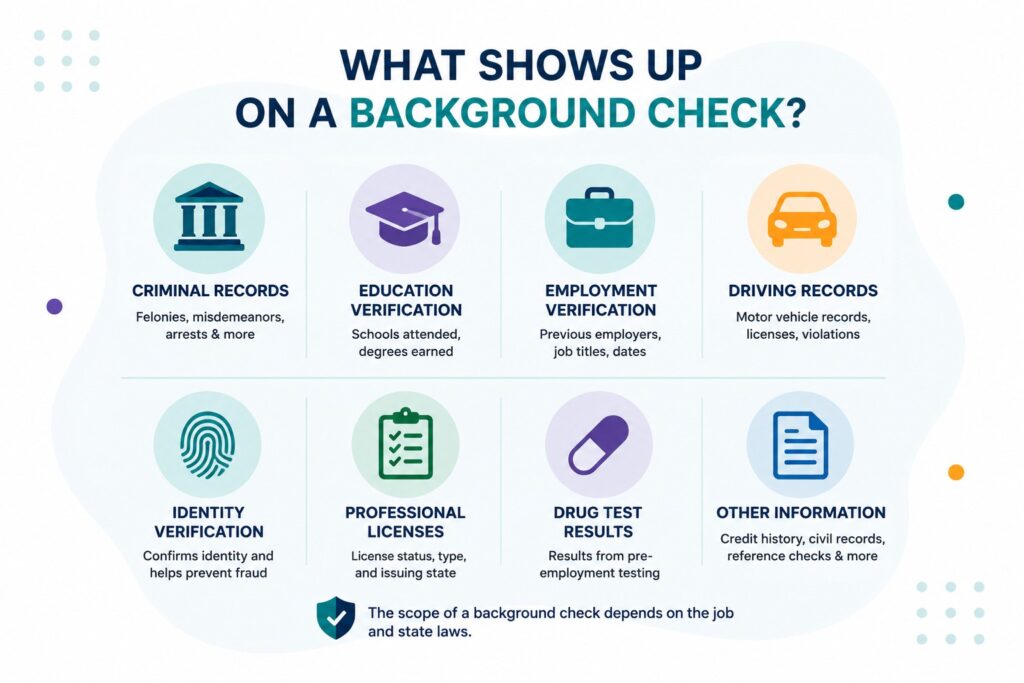
“What shows up on a background check” doesn’t have a single fixed answer, it depends entirely on what the employer ordered, the applicant’s history, and the laws governing what can be reported in that specific state. But most employment background checks draw from a similar set of components, and understanding what each one actually covers helps demystify what an employer will, and won’t, actually see. For how the process works and who runs it, see what is a background check.

Important: Not every employer orders every type of check listed here. What actually appears depends entirely on the specific screening package the employer selected for the role.
Identity Verification and SSN Trace
Most background checks start with an SSN trace, a research tool that surfaces address history and known aliases associated with an applicant’s Social Security number. It isn’t a criminal search on its own, its main function is helping identify every jurisdiction worth searching for criminal records.
Criminal Records
Criminal history is usually the centerpiece of a background check, and it can be searched at several different levels:
- County criminal searches: Records maintained by local county courts, where most criminal cases originate
- Statewide criminal searches: Records aggregated at the state level, coverage varies significantly by state
- Federal criminal searches: Cases prosecuted in U.S. District Courts, such as fraud or interstate crimes
- National criminal database searches: A compiled, multi-source database, useful for identifying leads but not a substitute for court-level verification
What appears here, and for how long, depends heavily on state law. Convictions can often be reported indefinitely under the FCRA, while non-conviction and pending information follows different, sometimes shorter, rules depending on jurisdiction.
Employment and Education History
Employment verification confirms whether an applicant’s reported work history, employer names, dates, and job titles, matches what former employers actually have on record. Education verification does the same for degrees, certifications, and attendance dates, typically checked directly with the institution or through a clearinghouse. Neither of these carries a legal time limit the way criminal records do, though older records can be harder to verify in practice.
Driving Records (MVR)
For roles involving driving, a motor vehicle report can show license status, violations, accidents, suspensions, and CDL status where applicable. Reporting timeframes for driving records are set by each state’s motor vehicle agency, not a single federal standard, and serious violations like DUIs often remain visible longer than routine infractions.
Credit Reports
Credit checks are far more limited than most people expect, they’re generally restricted to specific roles involving financial responsibility, and a number of states ban or heavily restrict them for most positions entirely. When permitted, employment credit reports typically exclude the numeric credit score and focus on things like collections, bankruptcies, and civil judgments, subject to FCRA reporting limits.
Drug Testing
Drug testing results appear separately from the rest of a background check and depend on the testing method used, urine, hair, oral fluid, or blood, each with different detection windows. DOT-regulated positions follow strict federal testing procedures, while non-DOT roles allow employers more flexibility within applicable state law.
Other Possible Components
- Professional license verification: Confirms whether an applicant holds a claimed license or certification
- Sex offender registry searches: Checks available state or national registry data
- Global watchlist and sanctions searches: Checks against certain restricted party and sanctions lists
- Civil record searches: Lawsuits, judgments, and other noncriminal court matters, where relevant to the position
What Generally Doesn’t Show Up
A properly conducted background check should not include:
- Expunged or sealed records, in most circumstances
- Arrests without a disposition being clearly reported as such, without confirmation of the outcome
- Medical history unrelated to a specifically authorized drug test
- Information restricted by state reporting time limits, such as older non-conviction records
The Bottom Line
What shows up on a background check is really a combination of what the employer ordered and what state and federal law actually permits to be reported. Understanding each component, criminal records, employment and education history, driving records, credit, and drug testing, makes it much easier to know what to expect, and what protections apply, before a check is ever run.