
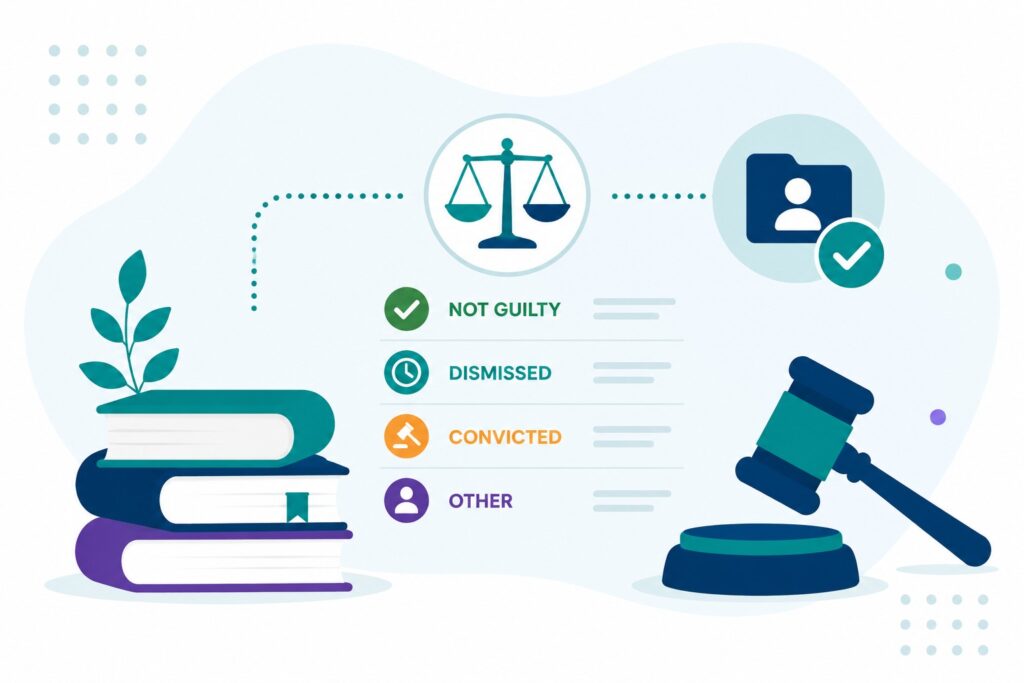
A disposition is the final outcome of a criminal case, what actually happened after an arrest or charge was filed. It’s one of the most important pieces of information on a criminal background check, because an arrest or charge without a disposition tells an incomplete, and potentially misleading, story on its own.

Important: An arrest is not the same as a conviction, and a background check that reports an arrest without its disposition can create a misleading impression. Employers should always look for the case outcome, not just the fact that a charge was filed.
What a Disposition Actually Is
When someone is arrested or charged with a crime, that case moves through the court system toward some final resolution. The disposition is that resolution, the answer to “how did this case end?” Without a disposition, a background check showing only an arrest or a filed charge doesn’t tell you whether the person was convicted, had the case dismissed, was found not guilty, or is still waiting for the case to resolve.
Common Types of Dispositions
- Convicted: The court found the person guilty, or the person pled guilty or no contest, and a conviction was formally entered.
- Dismissed: The charges were dropped before trial, for reasons ranging from insufficient evidence to a procedural issue.
- Acquitted: The case went to trial and the person was found not guilty.
- Nolle prosequi: The prosecutor formally declined to pursue the charges further, similar in effect to a dismissal but initiated by the prosecution rather than the court.
- Deferred adjudication: The court delays a final conviction while the person completes specific conditions, such as probation, after which the charge may be dismissed if conditions are met.
- Diversion: Similar to deferred adjudication, the person completes a program (often for lower-level offenses) in exchange for the charge being dismissed or reduced.
- Pending: The case has not yet reached a final resolution and is still moving through the court system.
Each of these means something meaningfully different, and reporting one as if it were another, treating a dismissed case the same as a conviction, for example, can create real problems both for accuracy and for compliance.
Why Disposition Information Matters So Much
An arrest by itself does not establish guilt. Plenty of arrests result in charges being dropped, reduced, or resolved without any conviction at all. A background check that reports an arrest without also reporting what happened afterward risks presenting incomplete information as though it were the full picture, which can unfairly affect a hiring decision based on something that was never actually proven.
This is part of why reputable background screening companies place heavy emphasis on verifying dispositions directly with courts, rather than relying solely on compiled database entries that may be incomplete or outdated.
Why Some Dispositions Are Missing or Incomplete
Disposition information doesn’t always make it into every database cleanly, for a few common reasons:
- Court recordkeeping delays, where the final outcome hasn’t been entered into the system yet
- Compiled databases that pull arrest data but don’t reliably update once a case resolves
- Cases still actively pending, with no final outcome to report yet
- Sealed or expunged records that have been legally restricted from further disclosure
A missing disposition doesn’t necessarily mean something is being hidden, it often just reflects a gap between when an arrest was recorded and when the court’s final outcome was properly logged and made accessible. This is exactly why court-level verification matters: a database record showing an arrest with no listed outcome should prompt a direct check with the court, not an assumption either way.
What Employers Should Do With Incomplete Disposition Information
Reporting an arrest without a confirmed disposition, or relying on outdated database information, creates real risk of an inaccurate or unfair background check. Employers should work with a screening provider that actively verifies disposition information at the court level rather than reporting raw arrest data as though it were the final word. If a disposition genuinely cannot be located or confirmed, that uncertainty should be reflected honestly in the report, rather than presented as though a conviction occurred.
How Pending Cases Are Handled
Pending cases, ones where no final disposition exists yet because the matter is still working through the court system, are generally still reportable, since there’s no final outcome to apply reporting time limits against. This differs from closed cases, where reporting limitations tied to the date of disposition may eventually apply. Employers should have a clear policy for how pending charges are considered in a hiring decision, since a pending case is legally different from a conviction and shouldn’t automatically be treated the same way.
Expunged and Sealed Records
When a record has been expunged or sealed by court order, it generally should not appear on a background check at all going forward, regardless of what the original disposition was. Rules governing expungement and sealing vary significantly by state, including which offenses qualify, how long after a case closes someone can apply, and what obligations screening companies have if a previously reported record becomes sealed after the fact.
Common Misunderstandings
“An arrest means the person is guilty.” Not true. An arrest is the start of a legal process, not its conclusion, and many arrests never result in a conviction.
“If a disposition is missing, the person is hiding something.” Not necessarily. Missing dispositions often reflect court recordkeeping delays rather than concealment.
“Dismissed and acquitted mean the same thing.” They don’t. A dismissal typically happens before trial for various reasons; an acquittal means the case went to trial and ended in a not-guilty verdict.
“Pending charges can’t be reported.” They generally can. Pending cases don’t have a final disposition to apply reporting time limits against, so they typically remain reportable while still active.
The Bottom Line
A disposition is what turns a bare arrest record into meaningful, usable information, the actual outcome of a case, not just the fact that charges were filed. Employers relying on background checks should insist on properly verified disposition information rather than raw, potentially incomplete database entries, since the gap between “arrested” and “convicted” can be the difference between an accurate hiring decision and an unfair one.