
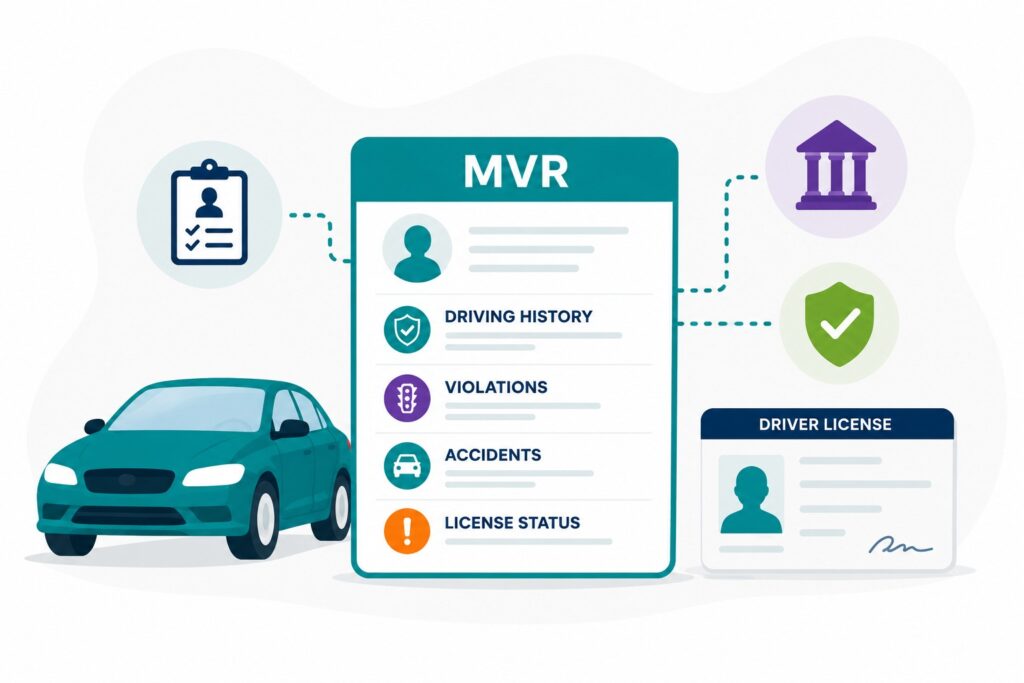
A Motor Vehicle Report, commonly abbreviated as MVR, is a record of an individual’s driving history maintained by a state’s department of motor vehicles. Employers request MVRs primarily for positions that involve driving as part of the job, and depending on the state, a report can reveal a fair amount about someone’s driving record beyond just whether they hold a valid license.

Important: MVR reporting rules, including what’s included and how far back it goes, are set individually by each state’s motor vehicle agency. There is no single national standard governing MVR content or retention.
What an MVR Typically Shows
- Current license status, including whether it’s active, suspended, or revoked
- Moving violations, such as speeding tickets or reckless driving citations
- At-fault and no-fault accident history, where reported to the state
- DUI or DWI convictions
- License endorsements and restrictions, including CDL classifications for commercial drivers
- Points accumulated under the state’s driver point system, if the state uses one
Not every category appears on every report, some states include more detail than others, and what’s disclosed can also depend on the specific type of MVR requested.
Why Employers Request an MVR
For any position where driving is a core job function, delivery drivers, sales roles involving travel, commercial truck drivers, positions requiring a company vehicle, an MVR helps an employer assess risk before putting someone behind the wheel on the company’s behalf. Beyond safety, there’s a real liability dimension: an employer who fails to check the driving record of someone in a driving-heavy role can face negligent hiring claims if that employee causes an accident with a known, unaddressed history of violations.
CDL and Commercial Driving Positions
Commercial Driver’s License (CDL) holders are subject to additional federal oversight beyond a standard MVR check. The Federal Motor Carrier Safety Administration (FMCSA) maintains its own drug and alcohol clearinghouse and violation reporting system specifically for CDL holders, and DOT-regulated positions carry stricter, federally mandated screening requirements that go beyond what a standard state MVR alone would cover.
How Long Violations Stay on an MVR
Reporting timeframes for driving violations vary considerably by state, there’s no single federal rule governing this the way there is for certain FCRA-covered information. As general patterns:
- Minor moving violations, like standard speeding tickets, often remain on record for a few years in most states
- DUI and DWI convictions frequently stay on record significantly longer than routine violations, sometimes for a decade or more depending on the state
- License suspensions and revocations typically remain visible for as long as they’re active, and often for a defined period afterward as well
Because these timeframes are set independently by each state, an employer checking driving records across a multi-state workforce may see different reporting windows depending purely on where the record originated, not because of anything different about the driver.
Does the FCRA Apply to MVR Checks?
When an MVR is obtained through a third-party consumer reporting agency as part of employment screening, it’s generally treated as a consumer report under the FCRA, meaning the same disclosure, authorization, and adverse action requirements apply as they would for any other type of background check. Some employers assume driving records fall outside FCRA coverage since they come from a government agency, but the obligation attaches to how the report is obtained and used for employment purposes, not simply to the source of the underlying data.
Point-in-Time vs. Continuous Monitoring
A standard MVR check reflects a snapshot of someone’s driving record at the time it’s pulled. For roles where driving is an ongoing, safety-sensitive responsibility, some employers use continuous monitoring services instead, which alert the employer if a new violation or license status change occurs after the initial hire, rather than relying solely on periodic manual rechecks. This is increasingly common for commercial driving positions specifically, given the higher liability stakes involved.
What Employers Should Consider Before Denying Employment
As with other background check components, an MVR shouldn’t be treated as an automatic pass/fail filter without context. A single older speeding ticket carries very different weight than a recent pattern of serious violations or an active suspension, and the relevance of any given violation depends heavily on the specific driving responsibilities of the role. Employers should have a clear, consistently applied policy for how MVR findings factor into a hiring decision, rather than making inconsistent case-by-case judgment calls that could appear arbitrary or discriminatory later.
Common Misunderstandings
“An MVR is the same everywhere.” Not true. Content, retention periods, and point systems are all set individually by each state.
“MVRs aren’t covered by the FCRA since they come from a government agency.” They generally are covered, when obtained through a consumer reporting agency for employment purposes, the same FCRA obligations apply as with any other background check component.
“Any moving violation disqualifies a driving applicant.” Not necessarily, and treating it that way without individualized context can create its own legal risk. Relevance, recency, and severity all matter.
The Bottom Line
An MVR gives employers a window into an applicant’s driving history, but what it actually shows, and for how long, depends entirely on the state where the record originated. For driving-related positions, it’s a meaningful risk management tool, but one that works best when applied with context and consistency rather than as a blunt automatic disqualifier.