
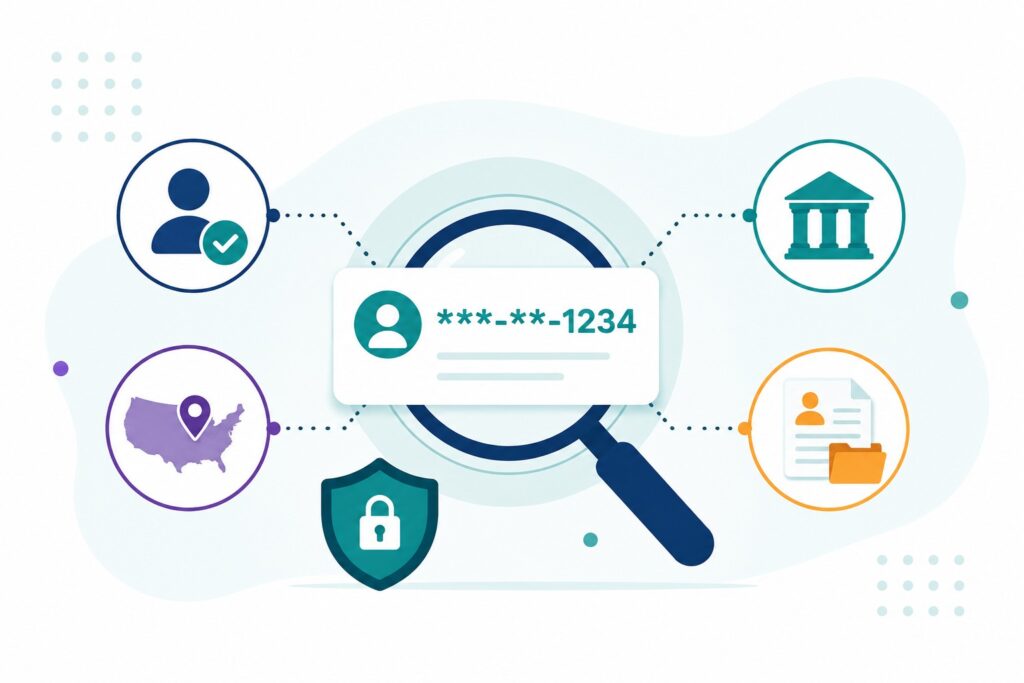
An SSN trace is one of the most commonly ordered, and most commonly misunderstood, components of a background check. Despite its name, it isn’t a criminal search, and it doesn’t verify identity on its own. It’s a research tool that helps point a background check in the right direction, and understanding what it actually does, and doesn’t do, matters for interpreting what shows up in a report.

Important: An SSN trace is not a criminal record check, and a clean SSN trace does not mean an applicant has no criminal history. It’s a research tool used to identify where else to search, not a substitute for an actual criminal records search.
What an SSN Trace Actually Does
An SSN trace searches a compilation of credit header data, public records, and other databases associated with a given Social Security number. Rather than confirming someone’s identity outright, it surfaces historical information tied to that number, which is then used to guide the rest of the background check. A typical SSN trace may return:
- Names and known aliases associated with the number
- Address history, often spanning several years or more
- Date ranges associated with each address
- Whether the number appears in any death master file or fraud-related flags
This information doesn’t answer the question “is this person who they say they are” by itself, it helps identify additional jurisdictions and record sources worth searching, based on where the applicant has actually lived.
Why Employers Use It
The primary value of an SSN trace is that it reveals address history the applicant may not have disclosed, or may have genuinely forgotten. Criminal records are generally maintained at the county or state level, so knowing every jurisdiction someone has lived in is critical to running a complete, accurate criminal search. Without an SSN trace, a screening company might only search the counties or states an applicant explicitly listed, potentially missing a jurisdiction where a record actually exists.
In this sense, the SSN trace functions less like a checkpoint and more like a map, it tells the screening company where else to look before the actual record searches happen.
Why It Isn’t Full Identity Verification
A common misconception is that an SSN trace confirms someone’s identity. It doesn’t, not on its own. It confirms that a number has a history of being associated with certain names and addresses, but it doesn’t verify a government-issued ID, confirm a photo match, or authenticate that the person providing the number is actually who they claim to be. True identity verification typically involves separate steps, comparing a government ID, biometric data, or knowledge-based authentication questions against the applicant, distinct from what an SSN trace alone provides.
What Discrepancies Can Mean
Sometimes an SSN trace turns up information that doesn’t line up cleanly with what an applicant provided, a name that doesn’t match, an address the applicant never disclosed, or a number associated with someone else entirely. These discrepancies don’t automatically mean something is wrong, there are several common, non-fraudulent explanations:
- A legal name change due to marriage, divorce, or a personal name change
- A typo made by the applicant, the employer, or the screening company when entering the number
- A shared or transposed digit that happens to match another individual’s number
- Outdated address data that hasn’t been updated in the underlying database
That said, some discrepancies can indicate a more serious issue, such as identity theft, an invalid or fabricated number, or an applicant attempting to obscure their actual history. Employers generally should not treat a discrepancy as an automatic red flag without giving the applicant an opportunity to explain it, but a discrepancy that can’t be reasonably explained is worth taking seriously rather than dismissing.
Why SSN Traces Aren’t as Reliable as They Used to Be
In 2011, the Social Security Administration changed how Social Security numbers are assigned, moving away from a system where the first three digits corresponded to a specific state or region. Before that change, part of an SSN’s structure offered a rough geographic clue about where it was originally issued. Since the change, numbers are assigned randomly, which means older assumptions about inferring location from an SSN’s structure no longer apply to numbers issued after the change. This makes the underlying database of address history, not the number’s structure itself, the primary source of useful information in a modern SSN trace.
How an SSN Trace Fits Into a Full Background Check
An SSN trace is typically run early in the screening process, before criminal record searches are ordered, precisely because its main function is to inform which jurisdictions those searches should cover. A typical sequence looks like:
- SSN trace run first, surfacing address history and known aliases
- Criminal record searches ordered for each jurisdiction identified, in addition to any locations the applicant directly disclosed
- Other verification components, such as employment or education checks, run in parallel or afterward
Common Misunderstandings
“An SSN trace is a criminal background check.” It isn’t. It’s a research tool used to identify where to search for criminal records, not a criminal search itself.
“A clean SSN trace means no criminal history.” Not true. An SSN trace can come back with no red flags and still miss a criminal record entirely, if the actual criminal search isn’t run in the right jurisdiction.
“Any discrepancy means fraud.” Not necessarily. Name changes, typos, and outdated address data are common, non-fraudulent explanations for a mismatch.
“An SSN trace verifies identity.” It doesn’t, not fully. It confirms an association between a number and certain historical data, not a government-issued identity match.
The Bottom Line
An SSN trace is a foundational, but limited, piece of the background check process. Its real value is in surfacing address history and aliases that guide where criminal record searches should actually be conducted, not in confirming identity or replacing a criminal search outright. Understanding that distinction helps both employers and applicants interpret an SSN trace result accurately, rather than reading more into it than it’s actually designed to show.