
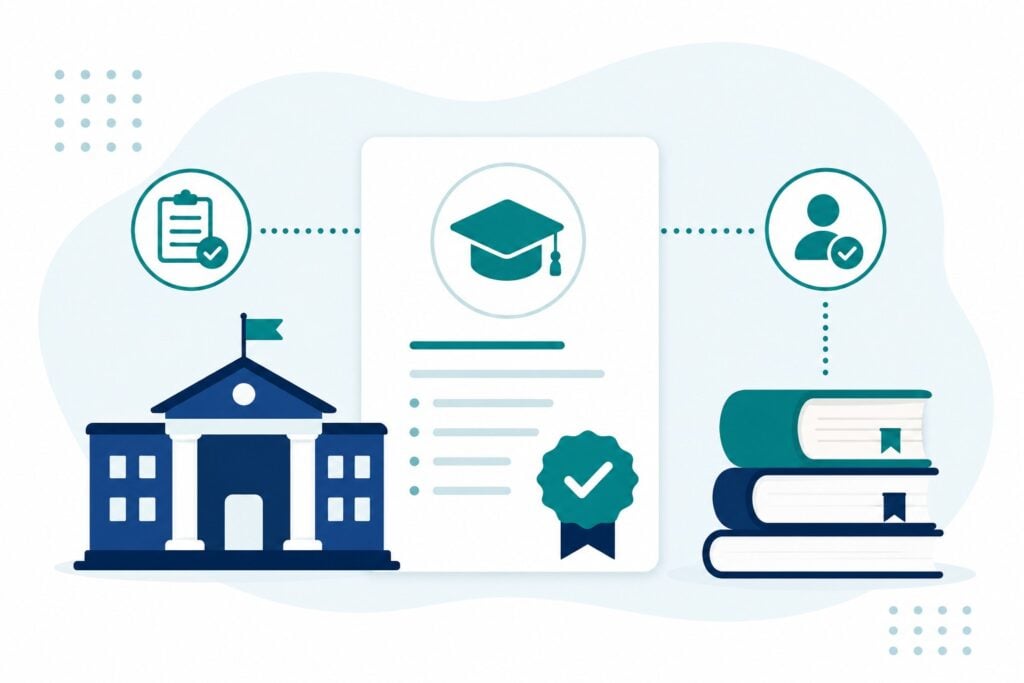
Education verification confirms whether the degrees, certifications, or attendance history an applicant lists actually match official school records. It’s one of the more overlooked parts of a background check, but degree fraud and resume inflation around education are common enough that skipping this step can leave a real gap in an employer’s understanding of a candidate’s qualifications.

Important: Education verification confirms records against the institution itself, or an authorized clearinghouse acting on its behalf. It does not evaluate whether a degree is a good or bad credential, only whether the applicant’s claim matches what the school’s records actually show.
What Education Verification Actually Confirms
Depending on what’s requested and what the institution is willing to release, an education verification can confirm:
- Whether the applicant actually attended the institution listed
- Dates of attendance
- Degree or credential earned, and the field of study
- Graduation date, or confirmation that a degree was never completed
- GPA, in some cases, though many schools do not release this without separate authorization
Some verifications confirm attendance only, without confirming a degree was actually awarded, which matters when an applicant lists a degree they attended school for but never completed.
How Education Verification Is Conducted
Verification generally happens one of two ways: directly through the school’s registrar office, or through a national clearinghouse that many institutions use to handle these requests on their behalf. The National Student Clearinghouse is the most widely used system of this kind in the United States, and it covers a large share of accredited colleges and universities, allowing verification requests to be processed electronically rather than through a phone call or letter to each individual school.
For schools not participating in a clearinghouse system, verification typically requires direct contact with the registrar’s office, which can take longer and sometimes requires a signed authorization form from the applicant before the school will release any information.
Why Employers Verify Education
Education verification exists to catch a specific, fairly common category of resume inflation: degrees that were never finished, institutions that don’t match what was listed, or credentials that sound legitimate but don’t hold up under a records check. For certain roles, particularly ones with licensing requirements, technical certifications, or degree-dependent regulatory standards, an accurate education record isn’t just a nice-to-have, it’s often a legal prerequisite for the position itself.
Diploma Mills and Fabricated Credentials
A diploma mill is an organization that issues degrees or certificates with little or no legitimate coursework, accreditation, or academic standard behind them, often for a fee and minimal effort. These operations can be difficult to spot at a glance, since many use official-sounding names designed to resemble real institutions.
Education verification is one of the more effective ways to catch this, since a legitimate verification check will typically reveal whether an institution is properly accredited and whether it actually has records matching the applicant’s claim. Employers evaluating an unfamiliar institution should confirm its accreditation status independently rather than relying solely on the applicant’s description of the school.
Common Issues That Slow Down Education Verification
- Name changes: Marriage, divorce, or other legal name changes can create mismatches between the name on file and the name provided by the applicant.
- School closures or mergers: Institutions that have closed, merged, or been acquired can make locating original records more difficult, though many closed schools’ records transfer to a state agency or successor institution.
- International institutions: Verifying degrees from schools outside the United States often requires specialized services familiar with that country’s educational system and recordkeeping practices.
- Incomplete or missing authorization: Some schools require a signed release before disclosing any information at all, and a missing or incomplete form can stall the request entirely.
What Schools Will and Won’t Release
Under the Family Educational Rights and Privacy Act (FERPA), schools have specific rules about what student information can be disclosed and to whom. Many institutions limit verification responses to attendance dates and degree conferral status, without releasing GPA, coursework, or disciplinary history, unless the applicant has specifically authorized a broader release. Employers should not assume every school will provide the same level of detail, what one institution confirms freely, another may require a separate signed authorization to release.
Common Types of Education Misrepresentation
Education-related discrepancies on an application generally fall into a few recognizable patterns:
- Listing a degree that was never completed, sometimes from a program the applicant genuinely attended but didn’t finish
- Inflating a certificate or minor course into a full degree
- Listing an incorrect graduation year, sometimes to obscure an employment gap
- Naming an unaccredited or fabricated institution designed to resemble a legitimate school
Not every discrepancy is intentional. Applicants sometimes misremember exact dates or misunderstand what their program officially conferred. Employers should generally give an applicant the opportunity to explain a discrepancy before treating it as an automatic disqualifier, particularly for minor date mismatches.
Legal Considerations for Employers
Education verification, like other background check components, generally requires proper disclosure and authorization under the FCRA when conducted through a third-party consumer reporting agency. Employers should also be aware that some states impose their own rules around how education records can be used in hiring decisions, and that FERPA governs what schools themselves are permitted to disclose, independent of what the employer is requesting.
Common Misunderstandings
“Any verification service can confirm any school.” Not necessarily. Schools not participating in a clearinghouse system may require direct contact and additional processing time.
“A verification confirms GPA and coursework automatically.” Often not. Many schools limit standard verification responses to attendance and degree conferral, unless a broader release is separately authorized.
“If a school closed, the records are gone.” Not always. Many closed institutions’ records transfer to a state higher education agency or a successor school, though locating them can take longer.
The Bottom Line
Education verification is a straightforward but often overlooked safeguard against resume inflation and outright credential fraud. It won’t catch every discrepancy instantly, some checks take real time depending on the institution, but it remains one of the more reliable ways to confirm that a listed degree, certification, or attendance record actually matches what the school itself has on file.