
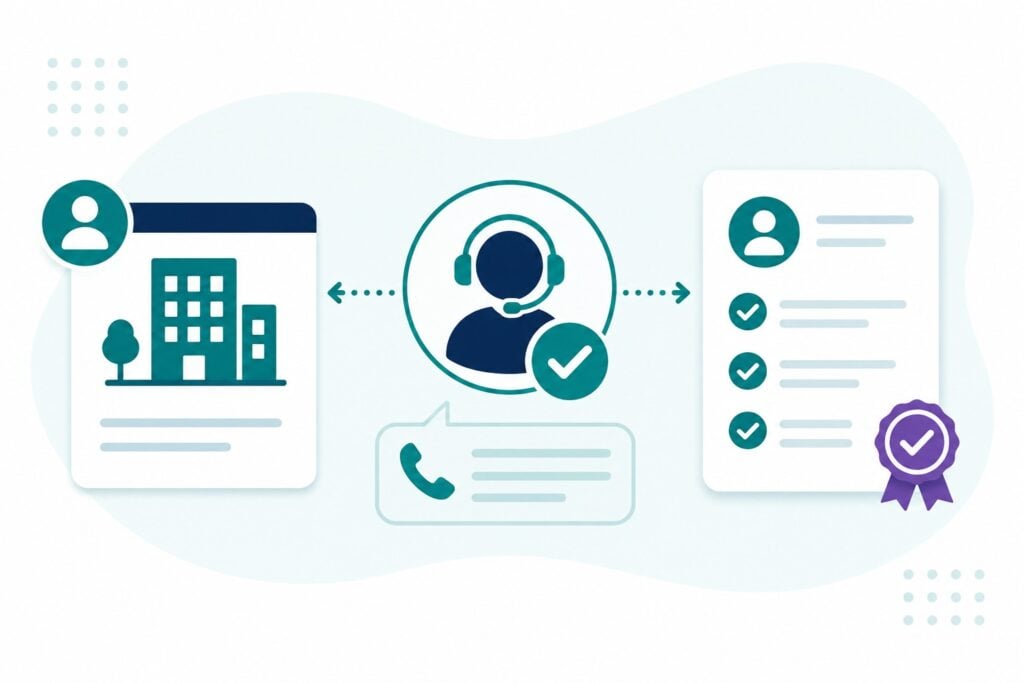
Employment verification is one of the most routine parts of a background check, and also one of the least predictable. Unlike a criminal record search, which typically queries a court database directly, employment verification often depends on a human being at a former employer actually responding, which makes it one of the more time-consuming steps in the screening process.

Important: Employment verification delays are usually not caused by the background screening company or the applicant. In most cases, they reflect how the former employer’s HR department, or a third-party payroll platform, handles incoming requests.
What Employment Verification Actually Confirms
Employment verification checks whether the work history an applicant reported on an application or resume matches what a former employer’s records actually show. Depending on what the employer is willing to disclose, this can include:
- Employer name
- Dates of employment
- Job title or position held
- Employment status (full-time, part-time, or contract)
- Eligibility for rehire
- Salary or compensation, when legally permissible and authorized
How much of this an employer actually confirms varies quite a bit. Many organizations, out of caution around liability and privacy, will only confirm dates of employment and job title, regardless of what else is asked. Others provide more detail depending on internal policy and applicable state law.
Why Employers Rely on It
Employment verification exists to catch inconsistencies between what an applicant reported and what actually happened, fabricated employment history, inflated job titles, incorrect dates, unexplained gaps, or details that simply don’t match the former employer’s records. For certain roles, work history is tied directly to experience requirements, licensing eligibility, or regulatory standards, in those cases, an accurate verification isn’t just useful, it’s a requirement, not an optional check.
What Is The Work Number?
The Work Number, commonly abbreviated as TWN, is an automated employment and income verification database operated by Equifax, and it’s one of the largest systems of its kind in the country. Many large employers, especially those using third-party payroll providers, route verification requests through The Work Number rather than handling them internally through HR.
When a screening company queries TWN, it can retrieve employment data electronically, employer name, employment dates, job status, and in some cases income and payroll information, without contacting the employer’s HR department directly at all.
Why Large Employers Use Systems Like This
A large employer can receive thousands of verification requests in a single year. Handling that volume manually would place significant strain on an HR department already managing hiring, onboarding, and employee relations. Automated systems like The Work Number help employers reduce the volume of inbound calls and emails, standardize how data is disclosed, limit the risk of inconsistent or unauthorized responses, and process requests at scale. As a result, screening companies increasingly work through platforms like this rather than reaching an employer’s HR team directly, this has become the norm for larger organizations, not the exception.
Why Employment Verification Costs More Than a Criminal Search
Employment verification is typically more expensive than a criminal record search, and there’s a real reason for that. Criminal searches generally involve querying a court database or a compiled record system. Employment verification, on the other hand, often requires manual outreach, multiple follow-up attempts, and in many cases, access fees charged by third-party verification platforms.
When a verification is routed through a platform like The Work Number, the screening company has to pay to access those records, and that fee is separate from the actual labor involved in managing the request. Cost factors typically include direct outreach to employers or HR departments, repeated follow-up attempts by phone and email, waiting periods outside anyone’s direct control, platform access fees, and review of supporting documentation when a record turns out to be incomplete.
Why Some Verifications Take Longer Than Others
Delays in employment verification are common, and in most cases, they have nothing to do with the applicant or the screening company. They reflect the day-to-day realities of how HR departments actually operate.
Employer non-responsiveness
Not every employer responds quickly. Small businesses may not have a dedicated HR function at all, while larger organizations sometimes deprioritize external verification requests when internal workloads are already heavy. Multiple follow-up attempts are frequently needed before any response comes back.
HR capacity and competing priorities
HR teams juggle a wide range of responsibilities, and an external verification request is rarely at the top of that list. During active hiring pushes, high turnover, or organizational change, response times can slow considerably.
Staffing shortages and backlogs
Many organizations run leaner HR teams than they used to, and a verification request can sit in a queue for days before anyone reviews it. Delays are especially common during holiday periods, large hiring cycles, mergers and acquisitions, and internal reorganizations.
Payroll provider authorization requirements
When verification runs through a third-party platform, additional authorization steps can add time, signed consent forms, identity validation, or employer account matching. If any detail doesn’t match exactly, the request can stall until the discrepancy is resolved.
Closed businesses and older records
Verifying employment from several years back introduces its own complications. If a company has closed, been acquired, or changed ownership, records may be difficult or impossible to locate, and many organizations only retain employment records for a limited window of time.
Can Applicants Help Speed This Up?
In some cases, yes. Applicants who provide complete, accurate information at the start of the process can meaningfully reduce delays. Helpful steps include:
- Using the correct legal name of the employer, not a parent company or subsidiary name
- Providing accurate start and end dates
- Including a direct HR contact or supervisor name when known
- Submitting authorization forms promptly and completely
- Providing pay stubs or W-2 forms if a record turns out to be difficult to locate
One common source of delay involves applicants who worked through a staffing or temp agency. In that situation, the agency is the actual employer of record, not the company where the work was physically performed. Listing the client company instead of the agency often leads nowhere, since the client typically has no employment records to provide at all. Applicants who worked through a staffing agency should list the agency itself, confirm its correct legal name, and provide any account or assignment details they still have on hand.
Applicants can also help by responding promptly to any texts or emails they receive during the verification process. Some third-party platforms contact applicants directly to confirm details or authorize release of records, these messages are easy to mistake for spam, but ignoring them can bring the entire verification to a complete stop until the applicant responds.
Why Accuracy Matters More Than Speed
Speed matters in hiring, but accuracy matters more. A verification that’s rushed or left incomplete can leave gaps in a candidate’s employment history, introduce inconsistencies, or create compliance concerns later on. For roles where experience or credentials are directly tied to job requirements, an unverified employment history isn’t a minor gap, it’s a meaningful unknown that shouldn’t be waved through just to keep a hiring timeline moving.
The Bottom Line
Employment verification is more involved than most people expect. Some requests resolve almost instantly through automated systems like The Work Number, while others require extensive manual follow-up with HR departments, payroll platforms, or archived records, and the actual timeline is rarely something any single party fully controls. What employers can control is working with a screening provider that documents every attempt, communicates clearly when delays happen, and treats accuracy, not speed, as the non-negotiable part of the process.