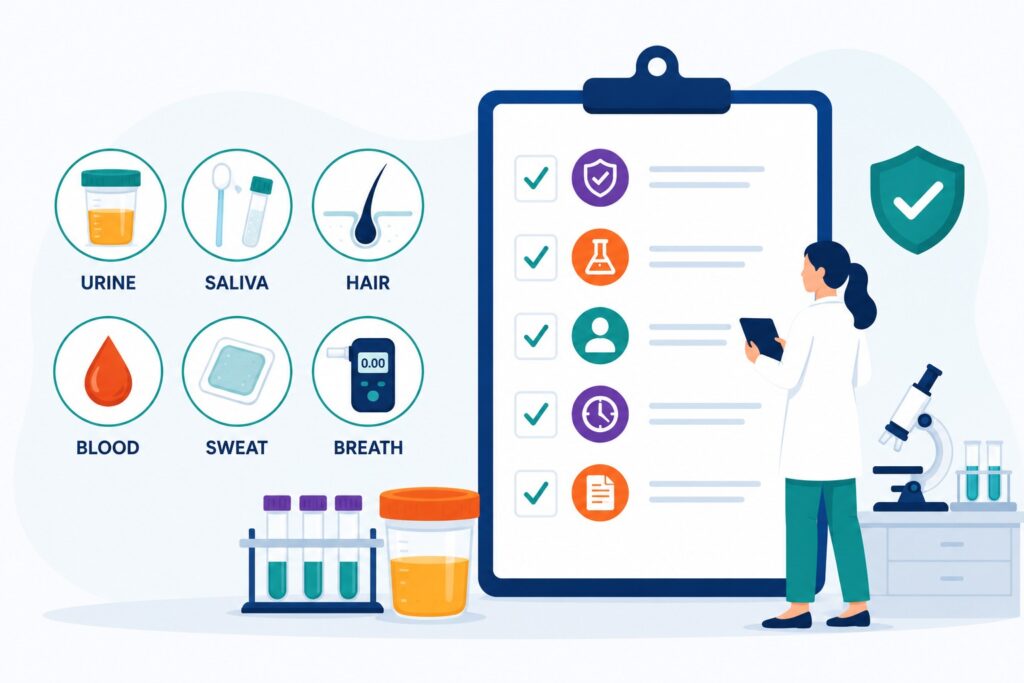
Drug testing is a common part of employment screening, but the term covers several distinct methods, each with different detection windows, different substances they’re built to catch, and different rules governing when and how they can be used. Understanding the differences matters for employers building a compliant testing program, and for applicants trying to understand what a specific test is actually checking for.
This guide walks through the main types of workplace drug tests, how they compare, and where federal, state, and industry-specific rules affect which test an employer is required, or allowed, to use.

Important: Drug testing rules vary significantly by state, industry, and job type. Employers should confirm applicable state and local requirements before implementing or relying on any testing program, since rules in this area change frequently, particularly around marijuana.
Urine Testing
Urine testing is the most common method used in employment drug screening, and it’s the method required for federally mandated testing programs. It generally detects recent drug use, typically within the past several days, though this varies significantly depending on the substance, frequency of use, and individual metabolism.
Urine tests are typically processed in two stages: an initial screening test, followed by a confirmation test using gas chromatography-mass spectrometry (GC-MS) if the initial screen returns a positive result. This two-step process exists specifically to reduce false positives, since certain foods, medications, and other substances can sometimes trigger a positive result on the initial screen alone.
Hair Follicle Testing
Hair testing detects drug use over a much longer window than urine testing, generally covering the past several months rather than days. As hair grows, it incorporates trace chemical markers from substances in the bloodstream, creating a longer historical record than other test types can capture.
Because of this extended window, hair testing is sometimes used for pre-employment screening in industries where a longer look-back period is valued, though it is generally not useful for detecting very recent use, since it takes time for hair to grow out enough to be tested.
Oral Fluid (Saliva) Testing
Oral fluid testing has a shorter detection window than urine or hair testing, generally covering very recent use, often within the past day or two. This makes it particularly useful for post-accident or reasonable-suspicion testing, where an employer wants to understand whether someone was likely impaired at a specific recent point in time, rather than screening for general drug use history.
Oral fluid testing is also less invasive to administer than urine testing and can be observed directly by a collector, which reduces some of the logistical and privacy concerns associated with urine collection.
Blood Testing
Blood testing is the most invasive and least commonly used method in routine employment screening, though it can provide precise information about current impairment level, since it measures substances actively present in the bloodstream rather than metabolized traces. Blood testing is more commonly associated with post-accident investigations, particularly in safety-sensitive industries, or specific legal and medical contexts, than with routine pre-employment screening.
Sweat Patch Testing
Sweat patch testing involves a patch worn on the skin over an extended period, typically used in monitoring situations, such as probation, parole, or court-ordered drug testing programs, rather than standard pre-employment screening. It’s less common in general workplace testing but relevant in specific compliance or monitoring contexts.
DOT vs. Non-DOT Testing
One of the most important distinctions in employment drug testing is whether a position is subject to Department of Transportation (DOT) testing regulations. DOT testing applies to safety-sensitive transportation positions, such as commercial drivers, pilots, and certain rail and transit workers, and it follows strict federal procedures that leave employers little discretion in how testing is conducted.
- DOT testing requires urine collection specifically, following federally mandated chain-of-custody procedures
- DOT testing panels and cutoff levels are set by federal regulation, not employer preference
- Non-DOT testing gives employers more flexibility in